

For this year’s Lenten Midweek services at the Chapel of Our Savior, here in Seymour at the Lutheran Community Home (where I serve as chaplain), I decided to make use of a Lenten Midweek series put together by the Lutheran publishing website and blog, “Steadfast Press”, aka The Brothers of John the Steadfast. link found here.
Each week our Midweek Lenten sermons will take on what it means for Jesus to be our Lord, and focus each week on one of Christ’s works for our sake.
This week, in the face of our guilt, Christ’s work justifies us (declares us innocent, righteous).
Lenten Midweek I
Romans 3, John 8
12 March 2025
Chapel of Our Savior – Lutheran Community Home, Seymour, Indiana
+ In the Name of Jesus +
That portion of God’s Word which we consider today, the Holy Spirit caused the holy apostle St. Paul to write for our comfort and learning, placing a special emphasis on these words…
For there is no distinction: for all have sinned and fall short of the glory of God, and are justified by his grace as a gift, through the redemption that is in Christ Jesus, whom God put forward as a propitiation by his blood, to be received by faith. (Romans 3.23-25; ESV)
Let us pray:
O God, our Maker, Redeemer, and Comforter, we are assembled in your presence to hear your holy Word. We pray you so to open our hearts by your Holy Spirit, that we may be taught to repent of our sins, to believe on Jesus in life and in death, and to grow day by day in grace and holiness, hear us for Christ’s sake, Amen.
None is righteous, no, not one. All have turned aside. We all like sheep have gone astray, everyone, to his own way. No one does good, not even one. For all have sinned and fall short of the glory of God.
The Bible from Genesis to Revelation is very clear. Fallen man is not capable of achieving or living up to the glory of God. There are no exceptions. The Bible’s worldview sees man as totally incapable of choosing for God, choosing for the righteousness of God, according to man’s sinful nature.
We confess this every week in the Divine Service in our Lutheran Church: “We confess that we are by nature sinful and unclean. We have sinned against you, O God, in thought, word, and deed, by what we have done, and by what we have left undone. We have not loved you with our whole heart; we have not loved our neighbors as ourselves. We justly deserve Your present and eternal punishment.”
If we stopped there, the Bible would be one very sad story. If everyone is guilty as charged – and stays that way – there is no hope for the accused. The woman caught in adultery we heard about in today’s reading from John 8 would be condemned and stoned and cast into hell for eternity. We would all deserve to die both a temporal, earthly, present punishment. And we would all be condemned to eternal punishment in hell. No one is without sin.
Yet sitting in the dirt of our world, writing in the dirt with the finger of God that once wrote the two tables of the Law that condemn us all, is “a righteous God and a Savior,” Jesus Christ, “and there is none besides him.” (Isaiah 45) He stops the grim procession of death for the adulteress and for every convicted sinner. He writes into the ground with His finger wisdom from of old, yet forgotten by the Scribes and Pharisees so anxious to judge and condemn the lost sinner. Jesus writes with His finger that in His coming to be our advocate and defender from the devil’s accusations, true as they are, the old condemnation of the Law no longer stands, and a new verdict has come from heaven.
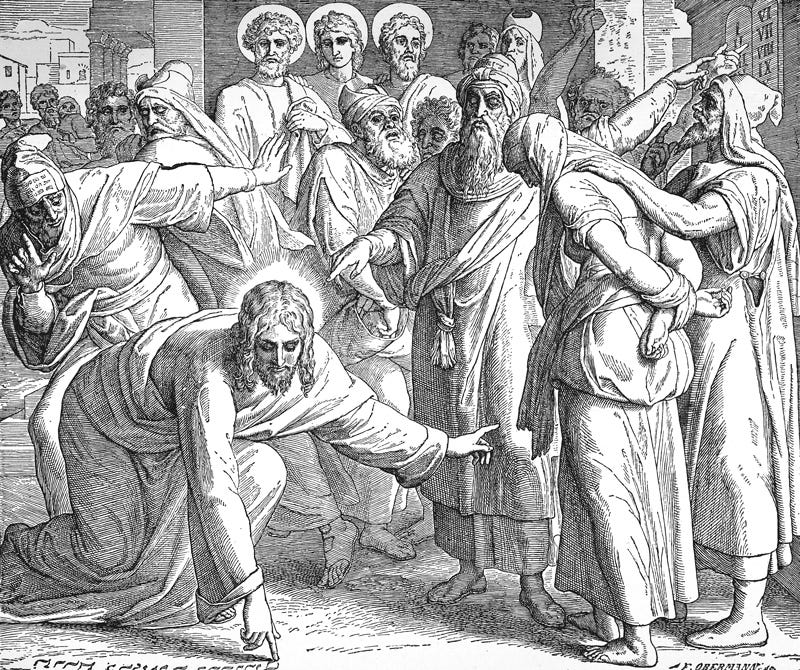
“Let him who is without sin among you be the first to throw a stone at her.” True enough. The stones dropped back to the earth one by one, and started once again to serve the purpose God made them for. No cries of “guilty” and for death to be exacted, no lynch mob justice today. No one is left to condemn. Not even the devil. Jesus is the advocate and defender of every sinner.
So please, if you’ve been in the habit of condemning yourself for your sins and mistakes and failures in life, drop the stones. If you’ve been in the habit of condemning others for their sins and mistakes and failures and have failed to see your own unrighteousness, drop the stones.
Instead, cast your eyes upon the one righteous man there is, and find yourself looking with this very surprised woman to the one innocent man who came to bring about a new verdict for a new kingdom: the Law of mercy and of the forgiveness of sins, written in His blood on the dirt of Calvary under His cross. No one, Lord, condemns me, Lord, united to you, through faith in you.
Jesus pronounced His absolution: “Neither do I condemn you. Go, and from now on sin no more.” It is as if He said to her:
“My father, in His infinite mercy, has given me over to die for you, and for the sake of what I am about to suffer on the cross, and because I am about to return into the dust in death for your sake, behold, I have written this in the ground here with my own finger. As the anointed Christ, I forgive you all your sins in the name of my Father and your Father, you who were guilty are now judged innocent for the sake of the blood I will shed, and I give to you the gift of the Holy Spirit so that from now on, living united with me in the Holy Church, the new Israel, you can lead a holy life free from sin and shame, delighting in my Father’s will, as I do, and walking in His ways, to the glory of my holy name.”
God grant that all of us would hear and recognize that we are guilty of our sins, and by grace daily repent and believe the Gospel, and so be brought over by Jesus from guilt to innocence, free in Him to sin no more by the power of the Holy Spirit. God grant this prayer, for Jesus’ sake. Amen.